


[inhabitat]
Previously named the DS400GB, the SmartMirror is a GPS system that is mounted in place of your conventional rear-view mirror, and has a rear-facing cam input. With Navigon Mobile Navigator 6.5 inside, it's got "reality view", a 4-inch touchscreen, integrated speakers and Bluetooth and takes SD cards. It's actually got two inputs for rear-view cameras, which may be good news for the parking-skill-challenged. It sounds like a neat solution, but I'm a little unconvinced that mounting a GPS high up there on the windscreen isn't actually going to distract you from looking in the rear-view mirror— after all, we know how distractingmGPS can be. SmartMirror will be available August 1st for $799.
[gizmodo]

New Swiss car, called “sQuba,” can drive on land and underwater. It was inspired by James Bond’s Lotus Esprit from “The Spy Who Loved Me” movie.
Rinspeed boss Frank M. Rinderknecht is known for his extraordinary automotive creations. The acknowledged James Bond enthusiast and Swiss automobile visionary kept revisiting this scene in his mind over and over: “For three decades I have tried to imagine how it might be possible to build a car that can fly under water. Now we have made this dream come true.”
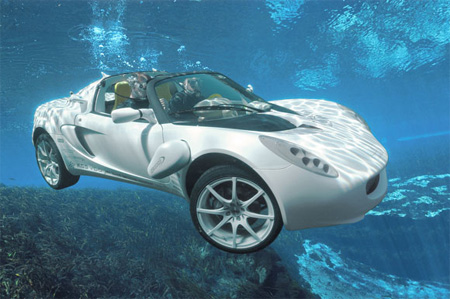
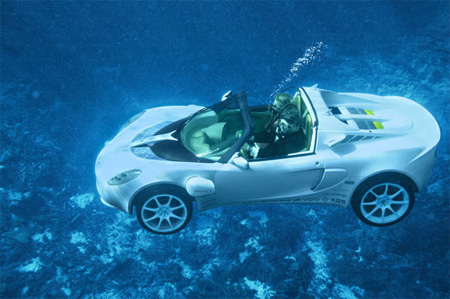
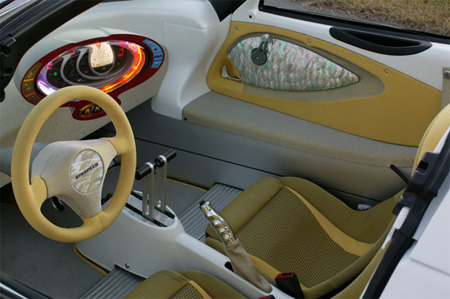
Power is supplied by rechargeable Lithium-Ion batteries. Rinderknecht: “The ‘sQuba’ is a zero-emission car as documented by the rotating license plate in the rear. It produces no exhaust emissions. The Swiss are among the world’s pioneers in the area of hydropower. The ‘sQuba’s’ filling station is the water reservoir.” It is no surprise that the vehicle features powerful yet energy-saving LED lighting technology.
[toxel]

[techtrivia]

[toxel]


f you like the fuel-efficiency of a motorcycle and the comfort of a car, the Carver One might be what you’re looking for. The Carver One is a hybrid car/motorcycle that is compact and fuel-efficient. It only has three wheels and uses Dynamic Vehicle Control to bank the vehicle around turns. Just like if it was a bike and had only two wheels.

The body is 11.2 feet long, 4.3 feet wide, and 4.6 feet high, so I would image it would be easy to park on a small crowded street. The driver seat is said to be comfortable, but the optional backseat leaves much to be desired. The Carver’s speed maxes out at about 115mph and has a manual five speed transmission.
Drivers of the Carver One say it’s like driving a roller coaster — which I can understand since it banks around turns, much like roller coasters do. People have also said that it handles smoothly in varied weather conditions.
This one part car, one part motorcycle is currently only for sale in Europe for around $44,000. They are working on getting past all the regulations so they can release it in the US before 2010.
[coolhunting]
This Anti Glare Driving Panel is an add-on LED lamp panel which you attach above the driving seat to reduce the glare from on-coming car lights at night. The idea is that the soft light from the panel shrinks your pupils slightly and so reduces the amount of glaring light that flows into your eyes from oncoming traffic.
OK look, it’s German right, so it must work. And if you’ve ever driven in Europe you’ll have seen the gradient lighting system they use in tunnels to acclimatise your eyes before you emerge into the open again. Anyway it’s an interesting concept isn’t it? The device costs €229.00 and can be self installed with the Velcro straps in minutes (it says here).

[redferret]
Two men from the Cincinnati-area hope that they have stumbled upon mankind's transportation woes, bringing together the best of an ultralight electric car with a monorail, resulting in the Liberator Car. Developed by Jay Andress and Andy Webster, the Liberator Car can be used to travel for short distances about town, and attached to a monorail should you wish to travel long distance, arriving at your destination shortly with a maximum speed of 200 mph. The rail will charge the car's battery, ensuring you won't run out of juice the moment you reach your destination. It would be interesting to see which government is willing to overhaul their transportation system to accommodate the Liberator Car in the future, but it will be a huge achievement when done.
[ubergizmo]
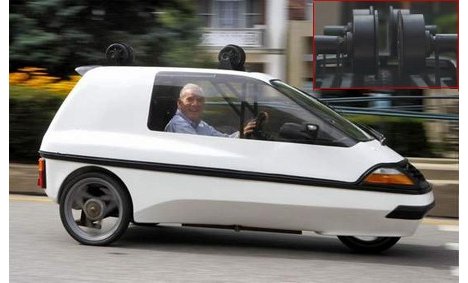
Combining solar power with electric power to run eco-friendly cars seem to be the new "in" thing to do, what with gas prices making driving a downright painful experience these days. Despite the fact that solar panels aren't really efficient enough to give much power to a car, auto makers will probably start slapping them on vehicles to make people think they'll be more fuel efficient.

The latest entry in this new genre is the Six50 by the Swiss company Mindset AG, designed by a former Volkswagen designer. It's still a prototype, but they plan on pumping out about 10,000 of these guys next year, each costing about $78,000. That's pretty steep for an untested model, but hey, your mileage may (literally) vary.
TH!NK, a Norwegian company, has developed a platform concept vehicle named ‘The Ox’. TH!NK Ox is a five-seater, fully electric car, which is capable of accelerating from 0 to 100km/hr in less than 8.5 seconds, and can reach a top speed of 130km/hr. The car’s connectivity platform, built on a computer, helps keep the driver fully aware of the car’s status via the use of Internet applications and GPS. This innovative clean car may really leave its mark on the fast growing market of electric vehicles.

The Ox’s batteries are centrally placed in two compartments in the lower frame. One can choose between two kinds of battery packs; The Zebra Sodium battery has high energy density, and provides long range independent of ambient temperature. The Zebra is “hot” battery, which means that its operating temperature is between 270 and 350 degrees. These batteries operate very efficiently in areas with very hot and very cold climate. The second type of battery is a Lithium-based system (from either A123 or Enerdel). Both lithium options operate at ambient temperatures. According to TH!NK this means that the car does not have to be plugged in when not in use.
Apart from the five-seat version, the same platform concept can be used to build an MPV version, suggested as a taxi, and a Coupe version, designed for higher performance.
Fully charged, TH!NK Ox's city driving range is targeted at over 250km. Charging the vehicle using the onboard charger is done from a standard 230V/16A European outlet and will take approximately 12 hours. If the car is powered by lithium-ion batteries, it will take less than an hour to charge it to 80% capacity using a high power off-board fast charger.
[thefutureofthings]
The Nikkei, Japan’s biggest business newspaper, re reports today [JP] Toyota will use solar panels in its next-generation Prius hybrid cars to be sold starting 2009. The company’s Japanese website doesn’t offer any official information so the news is yet to be confirmed.
The redesigned Prius will come equipped with solar panels on the roof, partly powering the air-conditioning system, which needs up to 5kw. According to the Nikkei, Toyota will procure the PV panels from Kyocera.
Toyota is the world’s first major automaker to install solar batteries on vehicles. It is not yet clear whether the solar Prius will be sold outside Japan as well.
[crunchgear]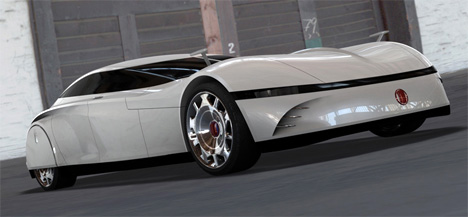

The last ten years has seen the resurrection of legendary auto brands like the Maybach, Bugatti, Healey, Mini and recently announced Alpine car brand. Tatra Motors, the third oldest car company on the planet behind Daimler Mercedes-Benz and Peugeot was the inspiration for this new concept design by Czech magazine AutoDesign&Styling. They asked designer Mike Jelinek to create this concept vision of the Tatra of the future. The result is the 903 Concept, a fuel cell luxury sportscar with innovative aerodynamic solutions. Jelinek adds, “The water drop shaped back refers to one of the most characteristic values of Tatra, the aerodynamics – same as covered rear wheels.” At present, Tatra only produces heavy trucks, but the this latest commissioned concept may get enough people excited to convince them to relaunch their passenger car line. Fingers crossed.
Designer: Mike Jelinek


The Antro Solo is a three seat gas-electric hybrid prototype made entirely out of carbon fiber. This material choice allowed the graphic designers to lower the weight of the vehicle to a measly 270kg. This also allowed them to achieve phenomenal fuel efficiency and a pretty decent top speed of 87mph. All of this is impressive enough, but the Solo’s designers were not content to stop there.
In order to maximize the efficiency of the vehicle, the designers installed solar panels on the roof. These solar panels store energy in the car’s batteries which can be used for short 15-25km trips. If there hasn’t been enough sun to power the batteries, each passenger’s seat comes equipped with pedals that can power the vehicles generator. If you are by yourself, or everyone gets tired, the car can switch to its small combustion engine that is capable of running on petrol or ethanol.
The prototype was shown at the Budapest Museum of Transport. It is set to go into production in 2012, and expected to cost around $20,000 dollars.
[inhabitat]
The Terrafugia Transition is a plane that thinks it’s a car. Or vice versa. Interesting factoids for you. They’re estimating a final price of $148,000, first production late 2009, cruise speed 115mph, range 460 miles, gas consumption 23 mpg, reverse gear, two seats and ethanol capable. So a Porsche it ain’t, but think of the glee as you fly over the I-95 donkeys on a damp Monday morning.
How will the Transition handle on the ground and in the air? A: The Transition will drive like a car on the ground and be controlled like a normal small airplane in the air. On the road, the Transition should handle well – it will be light weight, tightly controlled, and slightly overpowered. Due to its light weight and large side surface area, the Transition will be more sensitive to side gusts on the road. However, the Transition is aerodynamically stable on the ground as well as in the air, so a strong gust might cause minimal fish-tailing, but the vehicle will self-correct. Also, the center of gravity is low and well inside the wide wheel base of the vehicle, giving the Transition good stability on the ground.
[redferret]

Honda launched production of its first hydrogen-powered vehicles on Sunday in Tochigi, Japan. The four-door sedan, called the FCX Clarity, runs on electricity from a fuel cell battery that is powered by hydrogen fuel.
Steam is the hydrogen car’s only byproduct. The car can get a combined (city and highway driving) fuel efficiency of about 72 miles per kg of H2 which, according to Honda’s own estimates, is the equivalent of getting about 74 mpg on a gas-powered car. The car can be driven for about 280 miles before needing to be refueled.

The London Olympics Games will soon too be here and the UK will have a huge influx of visitors. To help with transportation a fleet of hydrogen hybrid fuel cell taxis are being introduced.
The fancy new cabs will be able to run all day without refueling, have a top speed of 120 kilometers per hour and will be able to stop faster than their gas-fueled counterparts.
London Olympics Games - Hydrogen Taxis [gadgettastic]

BatterySaver SE 2 Solar Battery Maintainer
This is an excellent battery maintainer that will keep a battery topped off when the vehicle is not in use. We recommend the BatterySaver SE for most standard automobile battery applications, SUV, Light Truck, Van, etc.
If you've ever been caught with a dead car battery, you know the inconvenience, cost, and danger it can cause.
BatterySaver SE will constantly replenish your car's battery by sending a maintenance-level charge to the battery of your vehicle. Uses male lighter adapter to plug in to your vehicle, or includes alligator clips as well. Lighter adapter use requires a lighter socket/power port that works with the key out of the vehicle. Use of silicone between panel and frame recommended for long term outdoor use.
